
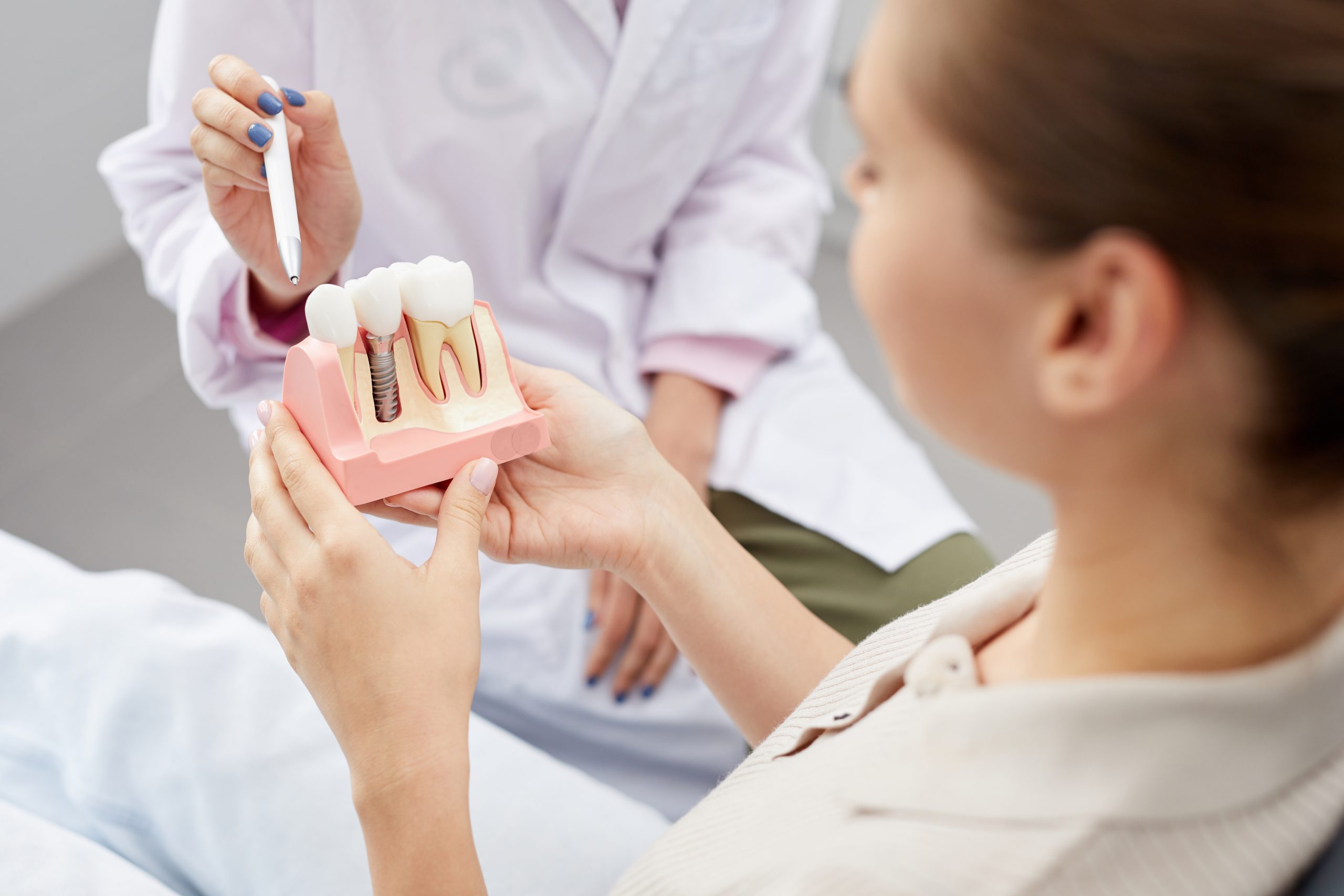
Choosing between dental implants and dentures usually comes down to how each is fitted to your mouth. Implants are fixed into the jaw, while dentures are removable because they sit on your gums. Treatment usually takes longer and costs more with implants, while dentures tend to be quicker and more affordable to start with.
Dentures vs implants also come down to how many teeth you’re replacing, and how you look after them day to day. Dentures can be full or partial, meaning they can replace all or some of your missing teeth.
Dental implants vs dentures: key differences
Dental implants and dentures can both be used to replace missing teeth, but they work in different ways. A dental implant is a small metal post placed into your jawbone to support a replacement tooth. After the area has healed, the replacement tooth is attached to your implant. Dentures are removable replacements for missing teeth that rest on the gums. A partial denture uses metal clasps that grip your neighbouring natural teeth, while a full denture relies on its fit and suction, and may sometimes be used with an adhesive to help keep it in place.
Here’s how the two options compare side by side.
| Key difference | Dental implants | Dentures |
| How they’re fitted | Placed into the jawbone to support a replacement tooth | Custom made to fit your mouth, they rest on the gums |
| Feel and stability | Designed to stay fixed in place | Can move slightly, particularly lower dentures |
| Effect on the jaw | Can help slow bone loss in the jaw after tooth loss | Do not prevent bone loss in the jaw |
| Daily care | Brushed and cleaned regularly, including around the implant | Removed daily for cleaning and usually soaked in a cleaning solution. |
| How long they may last | Can last for many years with good care | May need replacing or refitting after several years |
| Treatment time | Usually takes several months because healing is needed | Most dentures take a few weeks to make, although immediate dentures can sometimes be fitted on the same day as an extraction |
| Eating and speech | Function closely like natural teeth for most foods | Some patients find certain hard or sticky foods harder to manage, and upper dentures may affect taste slightly |
| Cost | Higher upfront cost | Lower upfront cost, see the cost comparison below for full pricing. |
If you’d like to understand what having an implant involves, our dental implants page covers the procedure in more detail.
Pros and cons of dental implants vs dentures
Dental implants
Pros:
- Fixed in place, so there’s nothing to remove when eating or speaking
- Replaces a missing tooth without relying on neighbouring teeth for support
- Doesn’t require special cleaning solutions or adhesives to stay in place
Cons:
- Involves surgery, usually taking several months because healing time is needed
- Costs more to start than dentures do
- Requires enough healthy bone to support the implant
Dentures
Pros:
- Doesn’t require surgery
- Usually costs less to start than dental implants
- Can replace several missing teeth or a full set in a single removable appliance
Cons:
- Doesn’t help prevent the bone changes that follow tooth loss, which can affect how well the denture fits over time
- Can take some getting used to, with extra saliva or minor speech changes possible in the first few weeks
Dentures vs implants cost
The cost of dental implants vs dentures in the UK can vary depending on the treatment you need. At Thorpe Dental Group, the price you pay depends on the treatment you need; dental implants start from £3,638, while a full denture for one arch starts from £1,170.
| Dental implants | Dentures | |
| Starting price | From £3,638 | From £1,170 (full denture, upper or lower) |
| Member discount | — | 20% off for members of our Adult Dental Plan |
These prices are starting points, and the total cost depends on the treatment you need. You can see the full breakdown, including partial dentures and pricing for both arches, on our fees page. The NHS has more on dentures, including typical charging bands, if you’d like to compare private treatment with NHS care.
Should you choose dentures or implants?
Your choice between implants vs dentures depends partly on your oral health and budget. It also comes down to how much you value a fixed option over a removable one.
Because the jaw is still developing in younger patients, dental implants are usually considered once growth is complete, which is often around the late teens or early twenties. Dentures may be used in the meantime. For adults, age on its own doesn’t usually rule out dental implants, although your overall health still needs to be considered.
Certain health conditions and habits can also affect implant treatment. Poorly controlled diabetes may affect healing, while smoking can affect the health of the tissues around an implant.
A consultation is the right way to find out which option suits you. If you’re in York and would like to discuss your options, our team can talk you through what each treatment involves.
Frequently asked questions
“False teeth” is simply another term for dentures, so this is the same comparison as dental implants vs dentures. Neither option is automatically better, and the right choice depends on your individual circumstances. Your dentist can talk you through the differences and answer any questions you have about replacing your missing teeth.
Denture implants, also called implant supported dentures, use dental implants to help hold a removable denture securely in place. They can provide more stability than a regular denture while still allowing the denture to be removed for cleaning.
Yes. Implants and dentures can be used together. A denture can be designed to fit onto a small number of implants for extra support and stability. This is sometimes known as an implant supported denture.
The cost of dental implants vs dentures varies depending on the treatment you need. At Thorpe Dental Group, dental implants start from £3,638 and a full denture for one arch starts from £1,170. For the full pricing breakdown, including the member discount, see our dentures vs implants cost section.